The Hidden Org Chart
AI operating model redesigns do not fail at the analytical layer. They fail at the authority layer.
The most interesting thing I see happening in enterprise AI right now is not technical.
Most of the conversation about AI transformation focuses on what to design e.g., data architecture, model strategy, operating model maturity, talent. The framing assumes the obstacle is analytical (I have even argued myself that it is structural) - it is deeper than that.
Every enterprise has two org charts. One is a document. The other is an agreement.
The first is the visible one - functions, divisions, reporting lines. It has been refined for decades.
The second has never been designed. It is the decision org chart: who actually controls each trade-off, who is consulted, who can override, and who absorbs the consequences when things go wrong. It is rarely written down. It has remained implicit by mutual agreement.
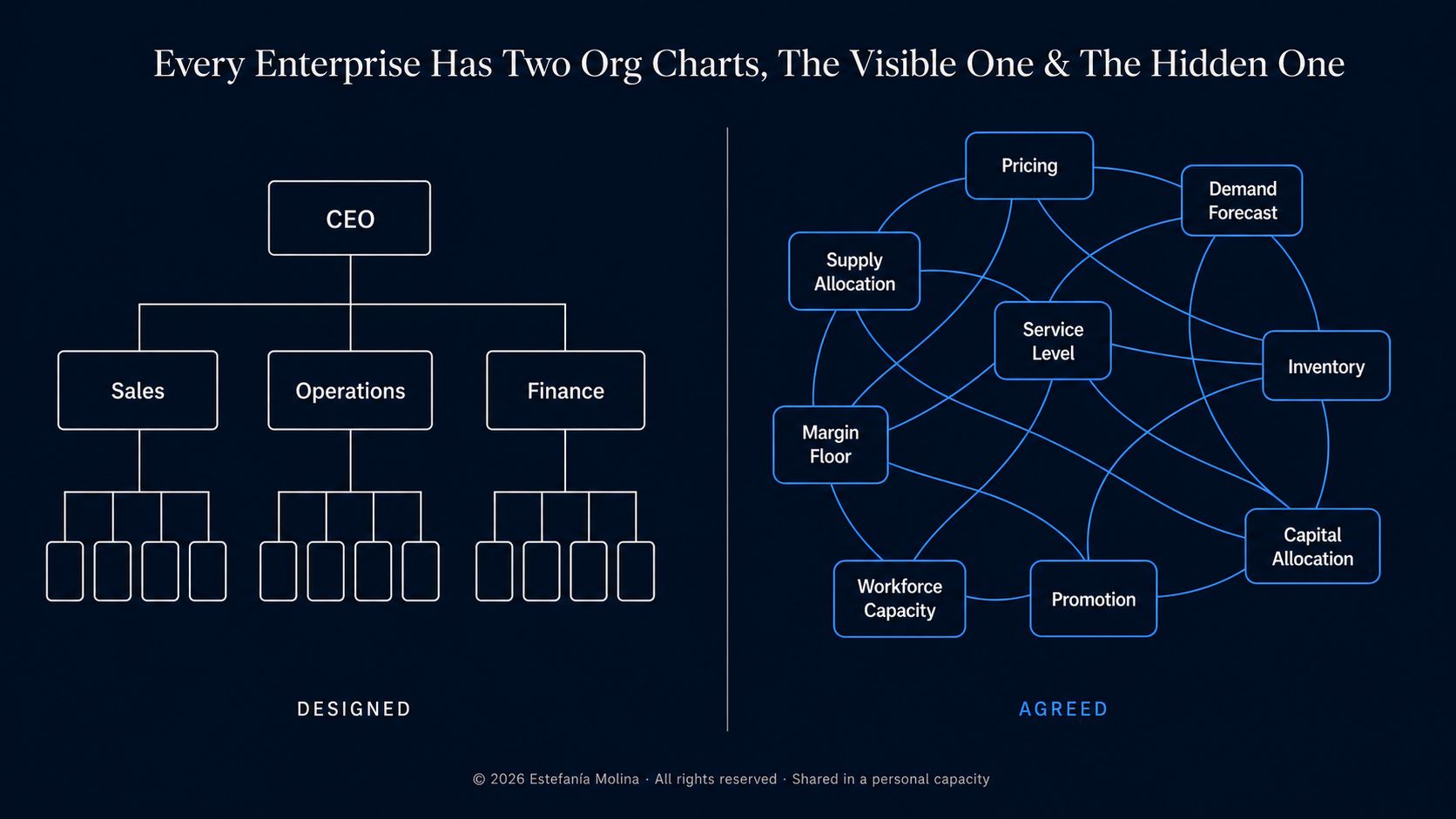
Exhibit · Every enterprise has two org charts. The visible one and the hidden one.
This was workable for a long time. Cross-functional decisions were rare and slow. Trade-offs were resolved in meetings, which gave implicit decision rights time to surface, contest, and settle through human judgment. No one had to admit, in writing, who actually held what.
AI changes this in a quiet but specific way.
AI operates on decisions. It does not negotiate with the functional chart. When pricing AI moves demand, supply absorbs the impact. When forecasting AI shifts capacity, workforce absorbs it. The trade-off has been made by a system, at a speed no human governance forum can match.
For a long time, none of this was visible. That has changed - not because anyone wants to look, but because the cost of not looking is showing up on the P&L.
What this exposes is not a technical problem at all.
The second org chart, if it were finally written down, would reveal who has been operating with authority they did not formally hold - and who has been quietly absorbing the consequences of decisions other functions made on their behalf. The conversation that follows is not analytical. It is about authority.
AI operating model redesigns do not fail at the analytical layer. They fail at the authority layer.
This is the most fascinating part of the AI transition to watch. Not because the technology is doing anything new, but because it is making visible something organizations have spent decades carefully not looking at.
The enterprises that compound the most value from AI in the next few years will not be the ones with the most sophisticated models. They will be the ones willing to look - and to write down what they have, until now, agreed to leave implicit.