AI Doesn't Equalize Thinking. It Amplifies It.
Cognitive differences amplify at the thinking layer, expose at the architecture layer, hide at the execution layer. Most organizations are still selecting from the broken signal.
One of my previous essays argued that the architecture of judgment is the moat - that the organizations which define how decisions are framed, trade-offs weighted, and outcomes governed will sustain meaningful differentiation as AI commoditizes execution. That argument holds.
But it leaves a prior question untouched: what determines the quality of thinking inside that architecture - and whether it compounds across the enterprise or quietly degrades?
The answer is not the models. It is not the platforms, the data infrastructure, or the use case portfolio. It is the cognitive disposition of the people operating within the system - and what AI is doing to that disposition, at scale, in ways almost no organization is measuring.
AI does not originate cognition. It accelerates and amplifies the cognition already present.
Brain capital and the unequal multiplier
Economists and neuroscientists have been developing the concept of brain capital - the aggregate cognitive capacity of a population - to describe the stock of mental capability available to solve problems, generate ideas, and navigate uncertainty. (Eric Topol, Harris Eyre, and others have built this out for nations, most visibly through the Brain Capital Index project.) The concept maps cleanly onto organizations.
Every organization has a brain capital distribution. Some people engage problems with rigor - pulling assumptions apart, testing conclusions against experience, refusing to settle for outputs that are merely plausible. Others engage more passively - finding consensus reassuring, accepting fluent-sounding answers, moving on. Both types have always coexisted. What has changed is the multiplier applied to each.
AI is not a great equalizer. It is a great amplifier. And what it amplifies is whatever was already there.
The passive thinker, given AI, moves faster. Output multiplies. Confidence increases. The cognitive gap between what they produce and what they have actually interrogated widens - invisibly, because the surface quality of the output no longer reflects the depth of the thinking behind it.
The rigorous thinker, given AI, encounters a sparring partner. Every output is interrogated. Structure is pulled apart. Premises are tested against experience. Hours disappear refining what a first pass got almost right - not because the output was wrong, but because almost right is insufficient. Their cognition does not atrophy. It intensifies.
The same tool. Opposite effects.
What does not show up in any dashboard: the distribution of cognitive dispositions inside the organization, and what AI adoption is doing to each of them. The passive thinkers are becoming more productive in ways that look identical, from the outside, to the rigorous thinkers doing something entirely different. Internally, one is compounding and one is hollowing.
Organizations did not historically need to explicitly select for cognitive rigor, because the work itself made it visible. Passive thinking produced visibly passive output - clumsy structure, weak logic, prose that gave its own shallowness away. The signal was in the artifact. Even a non-expert reader could usually tell rigorous work apart from passive work.
AI changes the artifact, not the thinking behind it. The same passive work that would once have disclosed itself now ships looking polished, structured, professional. The gap between rigorous and passive output has not narrowed - it has become invisible on the surface, even as the underlying difference is unchanged or widening.
Organizations can no longer distinguish AI-amplified fluency from genuine cognitive rigor. Most are sitting on a hidden distribution problem - they have both types, cannot easily identify which is which, and have handed everyone a tool that silently widens the gap between them.
This is the asymmetry that breaks the diagnostic: AI amplifies cognitive differences at the thinking layer, exposes them at the architecture layer, and hides them at the execution layer. The three layers used to track each other. They no longer do.
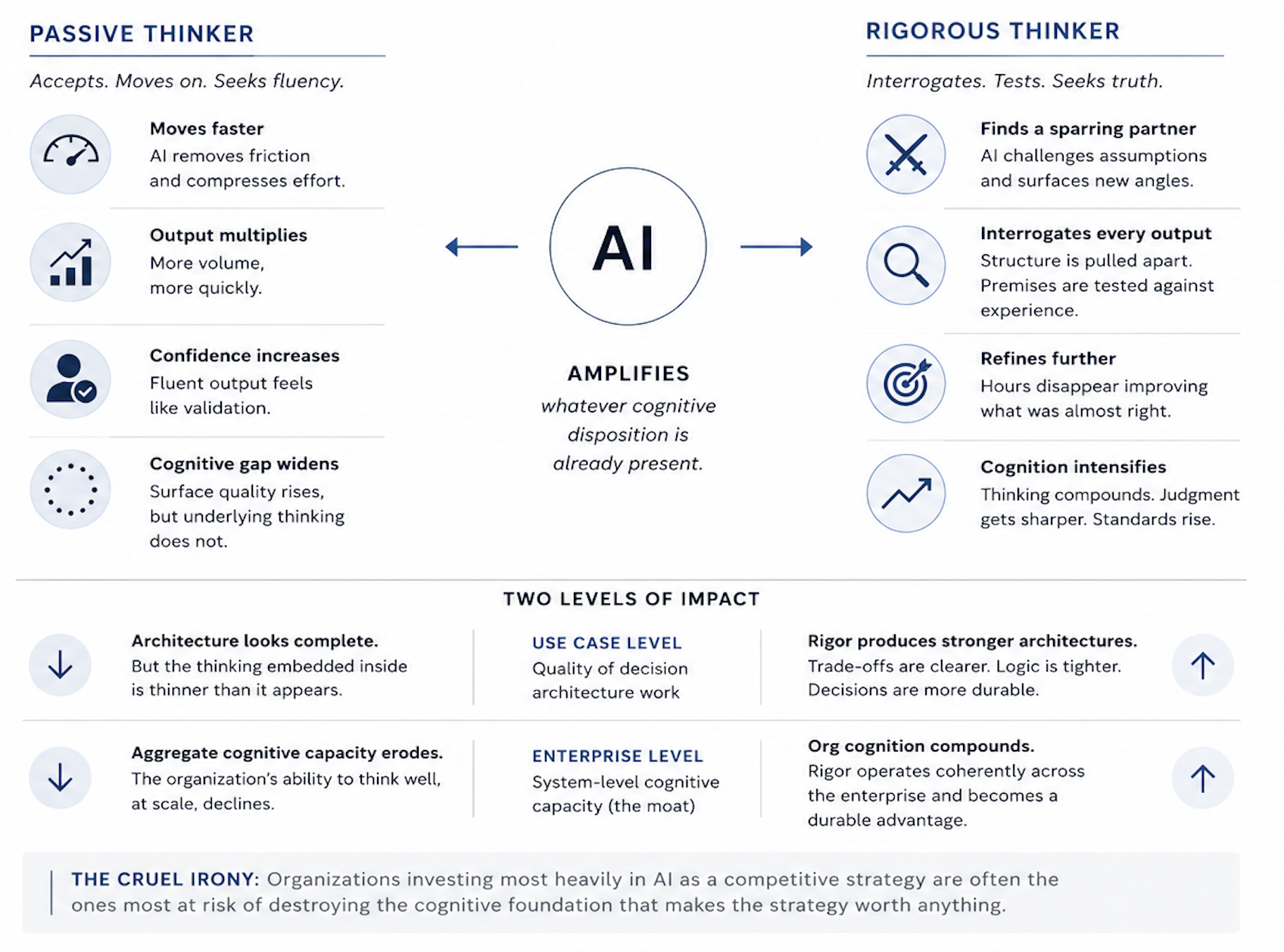
Exhibit · AI amplifies whatever cognitive disposition is already present
Where the damage compounds
The consequences compound at two scales - inside a single use case, and across the enterprise.
Inside a single use case, delegation-mode AI degrades the quality of decision architecture work itself. The bidirectional design pass described in the previous essay is granular, analytically demanding, and structurally difficult. It requires people who can hold a trade-off without resolving it prematurely, challenge a fluent-sounding framework, and remain genuinely unsatisfied until the logic is airtight. That is exactly the cognitive capacity that atrophies in people who consistently accept AI output rather than interrogate it. The use cases get built. The architecture looks complete. But the quality of the thinking embedded inside it is thinner than it appears.
Across the enterprise, the threat is larger. Org cognition - the system-level capacity to think well consistently, across every use case, every function, every consequential decision simultaneously - is not the sum of individual use case architectures. It is what happens when rigorous judgment operates coherently at scale. That is what sits above the commoditized execution floor. That is the moat.
And it is precisely what differential AI amplification erodes.
The organizations where passive thinkers are multiplied by delegation-mode AI are not just producing weaker individual use cases. They are degrading the aggregate cognitive capacity of the enterprise - the thing that was supposed to compound into durable advantage. The moat they believed they were building is filling in at the same time they are digging it.
The cruel irony: the organizations investing most heavily in AI as a competitive strategy are often the ones most at risk of destroying the cognitive foundation that makes the strategy worth anything.
Disposition or culture
Two implications follow, and both depend on a question that has not yet been asked: is the cognitive disposition I have been describing - the intrinsic motivation to engage with effortful thinking - fixed, or cultivable?
If stable and dispositional, the problem is a selection problem. Hire differently. Promote differently. Be honest about what you are actually selecting for when AI fluency appears on the job description.
If cultivable, it is a culture problem. Harder to solve, slower to change, but applicable to everyone already inside the organization.
My instinct is that it is both. Disposition matters, but environment shapes expression. A rigorous thinker in a culture that rewards speed over depth will eventually adapt downward. A more passive thinker in an environment where every output is seriously interrogated - where the norm is to push back, to refine, to be genuinely unsatisfied - will develop habits they would not have found alone.
Which means the cultural signal matters as much as the hiring signal. Leaders who visibly engage AI as a sparring partner - who interrogate outputs in public, who model the two-hour refinement rather than the five-minute acceptance - are doing something more important than demonstrating good practice. They are defining what cognitive engagement looks like inside the system. And that definition, over time, shapes the distribution.
What is at stake
The architecture of judgment is only as good as the cognitive quality of the people operating it - at the use case level, and at the scale of the whole enterprise. And that quality is not stable. It is being shaped right now, by how AI is being used, whether anyone has noticed or not.
AI is a mirror. It reflects and accelerates the thinking already present in the system.
The organizations that understand this will be deliberate about what they are amplifying. The ones that do not will discover the problem later - when the execution floor has risen, the moat has thinned, and the cognitive capacity to rebuild it has already quietly left the building.
The strategic question is not how fast you are adopting AI. It is what kind of thinking you are at risk of scaling.
Which raises a harder one - what an organization actually does with a distribution it can no longer measure.